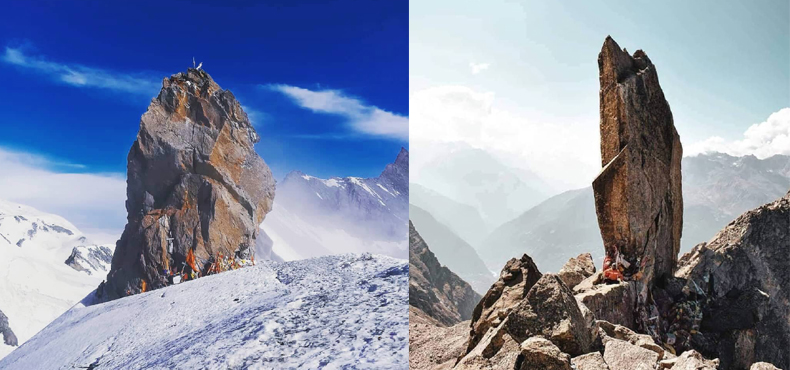
Not unlike most people, I had always been under the impression that whenever Kailash is mentioned as the abode of Lord Shiva, it refers to the Mount Kailash near lake Mansarovar, until I came across an article which mentioned that there are evidently about five clearly acknowledged Holy Kailash peaks in the Himalayan range and Panch-Kailash Yatra is indeed a great pilgrimage considered to be very sacred by the true devotees of Lord Shiva.

Reading about all of the Kailasha peaks, spread across the majestic Himalayan range, one in particular, the Kinner Kailash peak with the colossal Kinner Kailash Shivling, a 79-foot vertical rock monolith neatly balanced on a narrow rock slab, situated in the Kinnaur district of Himachal Pradesh drew my attention. Most legends agree that the Kinner Kailash is the winter home of Lord Shiva and that he used to hold a meeting of all Devi-Devatas atop Mount Kinner Kailash.
Initial Planning
The more pictures and videos I saw and more I read about the place, the more I felt it calling to me. And even though it became increasingly apparent that the trek, 14 kms long and traversing extreme Himalayan terrain, was by no means going to be an easy one, the resolve in my mind steadily grew. I found out that there are two main pilgrimages that are offered by devotees at Mount Kinner Kailash. One is the official Yatra to the holy Kinner Kailash Peak to see the Kinner Kailash Shivalinga, which is scheduled by the Kinnaur authorities, usually after the ending of the monsoon season in the region.
One needs to obtain permits from relevant departments before undertaking the same and it takes around 2-4 days to finish the trek. Another pilgrimage routinely offered by devotees which offers a more extensive trekking route is the Parikrama of the Holy Kinnaur Kailash mountain which takes anywhere from 6 to 15 days, with multiple stays at camping facilities during the trek and even involves negotiating a glacial pass. After much deliberation and thought, I decided to focus on the official Yatra as it was the shorter trek.
How to Reach Kinner Kailash
As luck would have it, with a group of like-minded friends I got my chance to experience the magical land first hand soon enough. The official Yatra was scheduled in the first week of August and as soon as the announcement was made we set about making arrangements for our journey.
The first task at hand was to decide how to travel from Delhi to Reckong Peo, the biggest town near the beginning point of the Yatra, and book tickets accordingly. A quick search revealed that the only available direct bus to Reckong Peo was an ordinary Himachal Road Transport Corporation bus which took around 19 hours to complete the entire journey, and maybe even more.
With the thought of the trek ahead, we didn’t really want to spend such a long journey in an uncomfortable bus so we decided to take a Semi-sleeper Volvo bus till Shimla and make further travel arrangements to Reckong Peo from there itself.
Another option available to us was to take a train from Delhi to Kalka, which in fact took much less time than a volvo, but we decided in favour of the volvo as it reached Shimla early in the morning, leaving us plenty of time to make arrangements for our travel to and stay in Reckong Peo.
Day 01: Delhi – Shimla
As the date of departure finally arrived, our bus was set to leave at 07.00 PM, which left me plenty of time to go over my packing. While it was important not to forget anything I might need, it was also imperative to keep the bag light and easy to carry.
Based on previous travel experiences and some research on the internet, I was carrying few but extra-warm clothes along with thermal tops and bottoms, warm gloves, and headgear as the temperature in the Kinner Kailash range tended to drop to negative figures even before winter completely sets in.
Also essential was a raincoat and good quality waterproof trekking boots, as the Yatra usually begins after the end of monsoon, but on the upper reaches of the Himalayas, rains are unpredictable and trekkers routinely face sudden and fierce bouts of downpour as they tackle the path.
As the trek is pretty remote, with few facilities en-route, it is also advisable to carry Flashlights, a personal kit including hygiene essentials and First aid kit as well as Water bottles equipped with carbon filters. Another important thing to carry was a sturdy yet lightweight sleeping bag.
The overnight journey from Delhi to Shimla in the bus was uneventful, but it is always a pleasant surprise to wake up in the morning and find the splendid Himalayas welcoming you with open arms. We reached Shimla early in the morning, refreshed and not in the least bit tired, and set about making inquiries for our journey to Reckong Peo.
It was difficult to resist the temptation to stay a day and explore Shimla, the Queen of Hills, once the summer capital of the British Empire in India, but for now our minds were set on the Yatra to the Kinner Kailash Shivalinga.
[ Also Read: Manali Visiting Places for Tourist ]
Day 02: Shimla – Reckong Peo (Powari / Tangling)
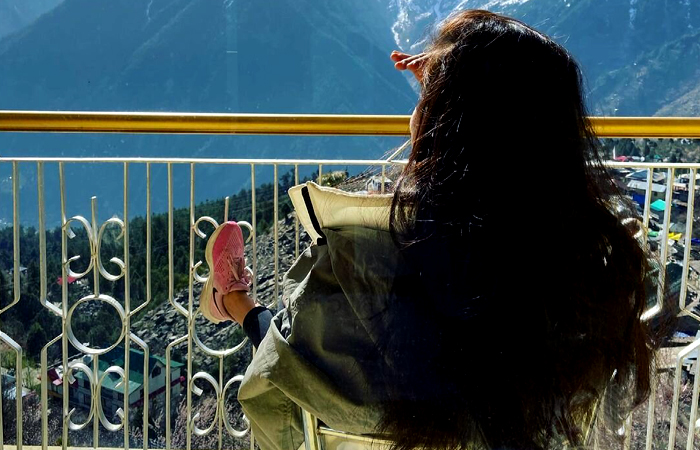
As it turned out, the two options available to cover the 225 km distance between Shimla and Reckong Peo was either a private cab or a Public Transport bus. Cabs were obviously faster and more expensive, costing anywhere from 4000 – 6000 rupees. If I had been a solo traveller, I would have definitely decided to take the local bus, but since the cab fare was to be divided among the group, the difference wasn’t really that much and the time saved by taking a cab seemed worthwhile since we still had to make arrangements for our stay in Reckong Peo for the night and also for beginning our trek the next day.
So it was decided, we booked a cab and our journey to Reckong Peo was underway. The drive as we left Shimla was as scenic as you would expect it to be, leaving the entire group in high spirits. As we climbed higher and higher on constantly winding roads the views became more and more breath-taking and it was almost impossible to resist the urge to ask the driver to stop at every turn to just take a moment to appreciate the fairy-tale beauty of the place.
However, intent on reaching our destination as early as possible, we pushed on, crossing Narkanda on our way and stopping at Rampur for a bit of lunch before driving on. The roads had been fairly well maintained up to this point, but now we saw that as the beauty of the surrounding landscape grew, the conditions of the road deteriorated steadily.
There was a high risk of landslides on this route and it is very common to find roads blocked due to them, but fortunately, we encountered nothing of that sort and smoothly reached our destination in the late afternoon. Our driver, a helpful chap as locals are inclined to be, on finding out that our intention was to complete the Kinner Kailash Yatra, advised us to find a place to stay in Powari or Tangling instead of Reckong Peo as it was nearer to the starting point of the Yatra than Reckong Peo and we decided to take his advice.
Even though most hotels or other stay options are centered around Reckong Peo or Kalpa, we had no difficulty in finding a place to stay near Powari that met our requirements, simple but clean and reasonably affordable. After settling down and freshening up, we went for a walk around the town to make inquiries about the Yatra and get the necessary permits.
Day 03: Tangling (Base Camp)
The next morning, we got up early and started off our journey by crossing the Satluj River on a Hand Driven Ropeway locally called the Jhoola Pul to reach the base camp at Tangling Village. One can also cross the river from Shongtong Bridge and reach the base camp by road.
The first phase of the trek was fairly pleasant, our path meandering around a swift mountain spring and crossing through an ancient forest of lofty Pines and Firs up and we reached the first stop along the trek, Darshan Park, before noon. Here a Langar was set up to provide meals to the devotees along with facilities to stay in camps and other basic amenities.
As there was still a long way to go, we had our meal, refilled our water bottles, and set off for our next stop, Ganesh Park where we intended to stay overnight. Onward from Darshan Park, the views became increasingly breath-taking and even though the path also became increasingly difficult to negotiate, it was still manageable as luckily we did not encounter any rain along the way.
However, we encountered the most difficult part of this phase of the trek just before we reached Ganesh Park. The downward path was fairly treacherous, and it was slow going while trying to maintain our footing. At one point, we even had to cross a small glacier, but all went well and we reached Ganesh Park before nightfall.
At Ganesh Park, some devotees choose to walk a bit further till they reach the Gufa or cave and spend the night there. However, we decided to spend the night in one of the camps at Ganesh Park itself. The facilities at Ganesh Park were bare essentials, yet we felt grateful for the simple yet fulfilling meal provided in the Langar and most of all for having a place to spread our sleeping bags and get some sleep.
Day 04: Tangling – Parvati Kund – Kinner Kailash Shivling – Ganesh Park
The next morning we started fairly early before sunrise onto our journey towards Parvati Kund and further up to the Shivalinga. After passing the cave, the landscape gradually changes from lush green meadows into a rocky terrain with huge boulders lining the path.
The path also became steep, almost perpendicular right before we reached Parvati Kund, and devotees afforded their first view of the Shivalinga from afar. The Kund itself is a very holy site, believed to be the first meeting point of Lord Shiva and Lady Parvati and many devotees take a dip in its freezing waters.
After the Kund, the Shivalinga was not far, but the route was the most difficult to cross, and we were almost crawling along the entirely rocky terrain for most part of it. However, all our efforts were rewarded as we reached the top around noon and beheld the massive Shivalinga standing tall and majestic. Strong winds blew all around us as we enjoyed the mesmerizing view of glaciers surrounding the peak.
However, we could not stay long to enjoy the view, as we still had the return journey to worry about. We offered prayers at the Shivalinga and began our slow and cautious way back to Ganesh park where we again intended to spend the night.
The downward path was no easier than the way up and we were hungry and exhausted by the time we reached our stop, well after darkness had fell. The night stay at Ganesh Park was much the same as last time, with basic food and a roof over our heads, but that was all we needed at that time, and felt eternally indebted for that.
Day 05: Ganesh Park – Tangling
The next morning we started back to Tangling after breakfast provided by the Langar. After yesterday’s incursions, the path from Ganesh Park to Tangling base camp felt relatively easy. We stopped at Darshan Park on our way back for some refreshments and reached Tangling base camp and from there to our hotel in Powari by evening.
Day 06: Powari – Shimla – Delhi Departure
The next day we left early as we had to reach Shimla before evening to catch our Volvo back to Delhi.
All in all, my experience of the trek was one that will stay with me for the rest of my life. A tough task to undertake, yet rewarding in itself, I am proud and happy to have witnessed at that peak both the grandeur and beauty of nature as well as the infectious supremacy of faith and devotion.
 Kanika Travel Blogger